
Water Coil DX
Introduction
Air Handling Units (AHUs) are essential components of HVAC systems, responsible for conditioning and circulating air within buildings.
One of the key cooling methods used in AHUs is the Direct Expansion (DX) system, which can be integrated with water coils depending on the system design and application.
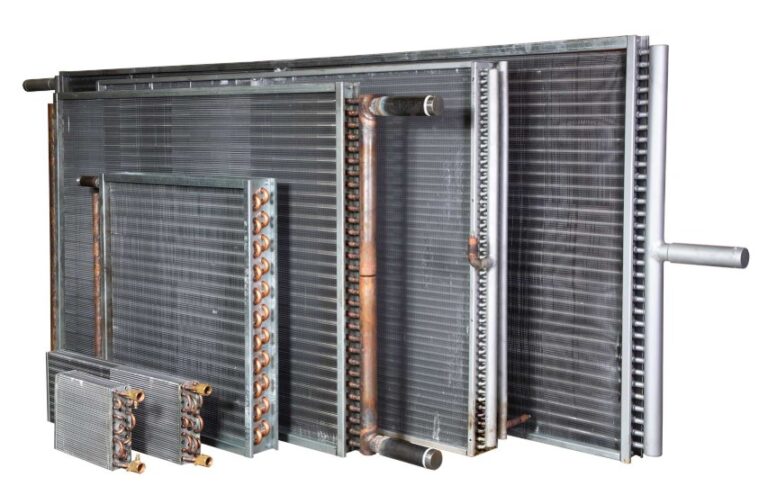
A water coil Direct Expansion (DX) system, commonly referred to in HVAC applications, represents a critical thermodynamic component within modern air handling units (AHUs) designed to simultaneously cool and dehumidify incoming air streams. Understanding the fundamental principles, design characteristics, and operational parameters of these systems is essential for professionals working in the concrete equipment and industrial machinery sectors, as similar thermodynamic principles apply to specialized cooling systems used in various industrial applications. A Water Coil DX system in an AHU refers to a cooling arrangement where heat exchange occurs either through chilled water flowing in coils or through a DX coil where refrigerant directly expands to absorb heat from the air. In some hybrid or comparison contexts, water coils are used alongside DX systems to achieve efficient cooling and humidity control.
In a DX coil, the refrigerant flows directly through the coil inside the AHU. As warm air passes over the coil, the refrigerant absorbs heat and evaporates, thereby cooling and dehumidifying the air. In contrast, a water coil uses chilled water supplied from a chiller plant, where heat is transferred from the air to the water.
The choice between water coil and DX systems in AHUs depends on factors such as building size, cooling load, energy efficiency, maintenance requirements, and initial cost. Water coil systems are commonly used in large commercial buildings due to their centralized control and efficiency, while DX systems are preferred in smaller or decentralized applications for their simplicity and lower installation cost.
Overall, water coil and DX-based AHUs play a crucial role in maintaining indoor thermal comfort, air quality, and energy-efficient operation of HVAC systems.
Working Principle
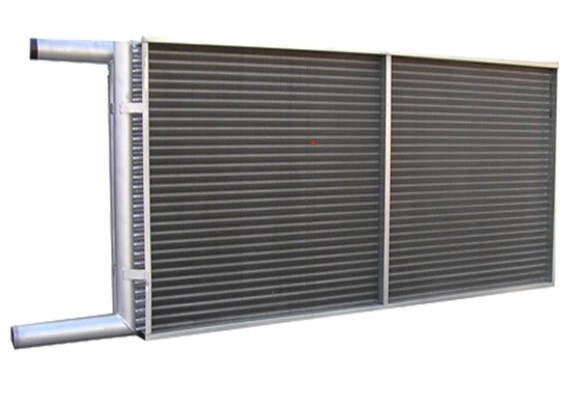
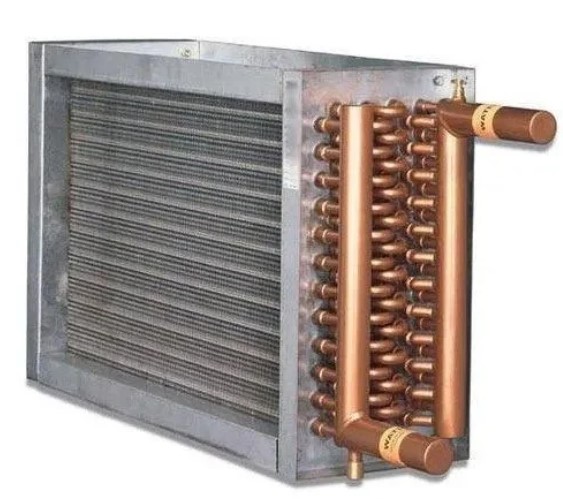
Water coil DX (direct expansion) coils in air handling units work as the evaporator of a refrigeration cycle, directly cooling and dehumidifying the air that passes over them. The basic principle is heat transfer from warm, moist air to cold refrigerant flowing inside the coil tubes.
Position in the refrigeration cycle
- The DX coil in the AHU is the evaporator; refrigerant comes from the expansion device at low temperature and low pressure and enters the coil as a cold liquid–vapor mixture.
- As air flows across the finned coil surface, the refrigerant absorbs heat and fully evaporates to low pressure vapor, then returns to the compressor to continue the cycle.
Air side process (what happens to the air)
- Warm return/fresh air from the space passes over the cold finned coil surface; sensible heat is removed, so air temperature drops.
- When coil surface temperature is below the air dew point, water vapor condenses on the fins, so latent heat is removed and humidity is reduced; the condensate is collected in a drain pan and discharged.
Refrigerant side process (inside the coil)
- The expansion valve or capillary drops the refrigerant pressure, causing part of it to flash into vapor and cool the remaining liquid.
- As this two phase refrigerant travels through the coil circuits, it absorbs heat from the air and gradually changes phase to saturated vapor by the outlet.
- Proper circuiting and distribution ensure uniform refrigerant flow so the entire coil face participates in heat transfer and no part of the coil “starves” or “floods.”
Heat transfer mechanism
- Overall capacity depends on:
- Temperature difference between entering air and evaporating refrigerant.
- Overall heat transfer coefficient (tube + fin materials, fin efficiency, fouling).
- Effective surface area (number of rows, fin spacing, face area).
- Both sensible (temperature) and latent (moisture) heat transfer occur simultaneously, and their ratio is expressed as the sensible heat ratio (SHR) for the coil.
Control and operation in AHU
- Coil output is typically controlled by:
- Refrigerant flow control (expansion valve, compressor capacity modulation).
- Airflow control (fan speed, dampers) and sometimes reheat downstream to fine tune supply air temperature vs. humidity.
- In many systems, supply air setpoint and humidity requirements determine the target evaporating temperature and thus the DX coil operating conditions.
Material of Construction
Material of Construction for Water Coil / DX Coil Used in Air Handling Units
The performance, durability, and efficiency of water coils and DX coils used in Air Handling Units (AHUs) depend greatly on the materials used in their construction. These materials are selected to ensure excellent heat transfer, corrosion resistance, mechanical strength, and long service life.
- Coil Tubes
Material:
- Copper (Cu) – Most commonly used
- Stainless Steel (SS 304 / SS 316) – For corrosive environments
- Aluminum (less common)
Reason for Use:
- Copper provides excellent thermal conductivity, ensuring efficient heat transfer between air and refrigerant/chilled water.
- Stainless steel is used where water quality is poor or in coastal and industrial environments due to its superior corrosion resistance.
- Coil Fins
Material:
- Aluminum (Al) – Standard material
- Hydrophilic-coated aluminum – For enhanced corrosion protection
- Copper fins – Used in special applications
Reason for Use:
- Aluminum fins increase the effective heat transfer surface area.
- Hydrophilic coatings improve condensate drainage, reduce water carryover, and enhance corrosion resistance.
- Headers and Distributors
Material:
- Copper – Common for DX coils
- Carbon Steel or Stainless Steel – For chilled water coils
Reason for Use:
- Headers distribute refrigerant or water evenly across the coil circuits.
- Materials are chosen based on pressure rating, fluid type, and corrosion resistance.
- Coil Frame / Casing
Material:
- Galvanized Iron (GI)
- Stainless Steel (SS)
- Aluminum
Reason for Use:
- Provides structural support to the coil assembly.
- GI is economical, while SS is preferred for hygienic or corrosive environments such as hospitals and pharmaceutical facilities.
- Tube Sheet / End Plates
Material:
- Galvanized Steel
- Stainless Steel
Reason for Use:
- Holds tubes firmly in position and maintains coil alignment.
- Must withstand thermal expansion and mechanical stress.
- Brazing and Joints
Material:
- Silver brazing alloy (for copper joints)
Reason for Use:
- Ensures leak-proof joints capable of handling high refrigerant pressure and temperature variations.
- Coatings and Surface Protection
Types:
- Epoxy coating
- Blue fin / Gold fin coating
- Anti-corrosion coating
Purpose:
- Protects fins and tubes from corrosion, especially in marine, coastal, or industrial atmospheres.
- Extends the operational life of the coil.
- Insulation (External Connections)
Material:
- Nitrile rubber (closed-cell elastomeric insulation)
- PU foam (where required)
Purpose:
- Prevents condensation and heat loss from chilled water or DX piping.
The materials used in the construction of water coils and DX coils in AHUs are carefully selected to balance thermal performance, corrosion resistance, durability, and cost. Proper material selection ensures reliable cooling performance, reduced maintenance, and long service life of the AHU system.
