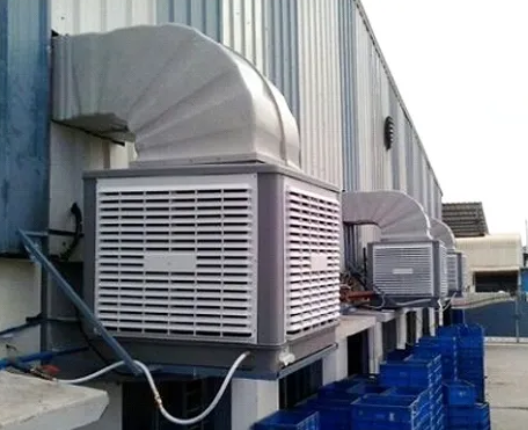
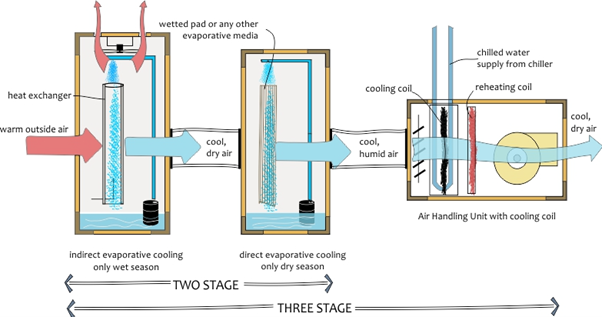
Evaporative Cooling

Introduction

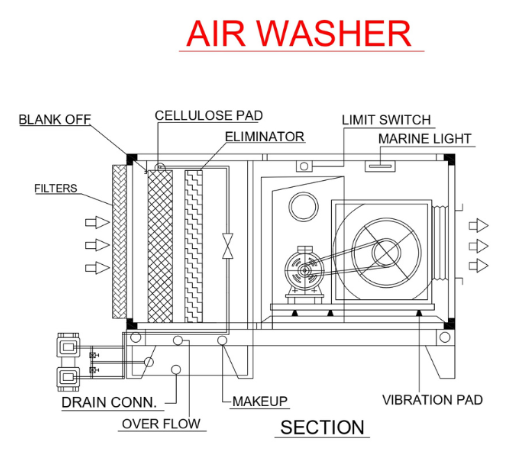
Air washers are sections within an Air Handling Unit (AHU) that condition air by direct contact with water. They are commonly used for cooling, humidification, and air cleaning in HVAC systems—especially where simple, robust conditioning is acceptable.


An air washer is an HVAC component that cools, humidifies, cleans, and sometimes dehumidifies air by bringing it into direct contact with water. In evaporative cooling, air washers rely on the evaporation of water to reduce air temperature without using refrigerants.

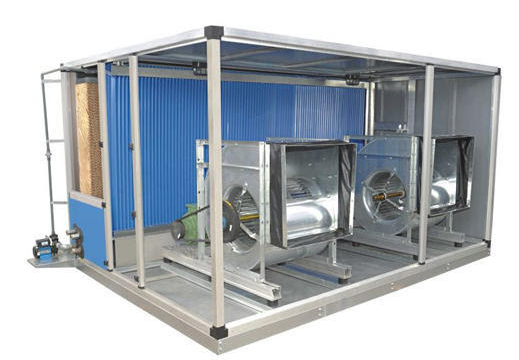
What an Air Washer Does

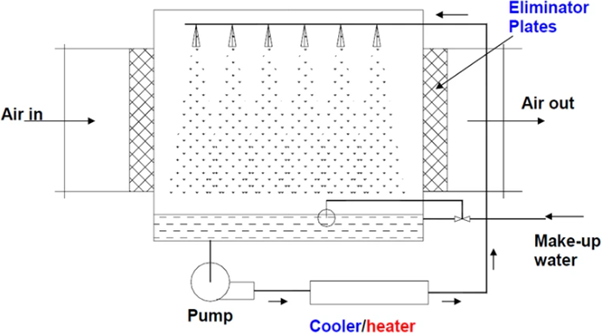
An air washer treats incoming air by spraying it with water:

Cools air via evaporative cooling

Humidifies air by adding moisture

Cleans air by washing out dust and soluble contaminants

Main Components

  1. Spray Chamber
  • Central part of the air washer
  • Contains multiple water spray nozzles
  • Ensures maximum air–water contact
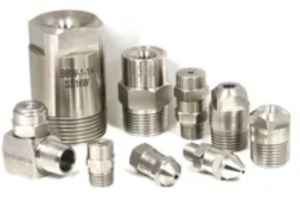
  1. Spray nozzles
  • Atomize water into fine droplets
  • Uniform spraying improves cooling and washing efficiency
  • Can be arranged in single or multiple banks
  1. Water sump (tank) – Collects and recirculates water
  2. Circulation pump – Feeds water to nozzles
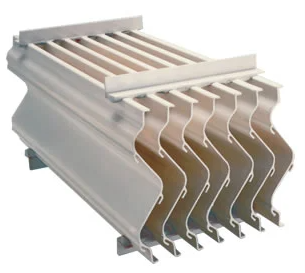
  3. Drift eliminators
  • Prevent water carryover downstream
  • Remove water droplets from air before it exits
  • Prevent moisture carryover
  1. Make-up & bleed-off lines – Control water quality
  2. Pre/Post filters – Protect equipment and improve hygiene

Working Principle

  1. Hot or dry air enters the washer section.
  2. Water is sprayed uniformly across the airflow.
  3. Heat and mass transfer occur between air and water.
  4. Air leaves cooler and/or more humid; dust is captured in water.
  5. Treated air moves to coils, fans, or supply ducts.

Types of Air Washers

  • Cooling-type (Evaporative): Lowers dry-bulb temperature; raises humidity
  • Humidifying-type: Adds moisture in dry climates or winter operation
  • Heating-type (Hot-water spray): Less common; used for winter humidification

Advantages

  • Simple construction and operation
  • Low initial cost compared to chillers
  • Provides cooling + humidification + filtration
  • Energy-efficient in hot, dry climates

Limitations

  • Limited temperature control and precision
  • Increases humidity (not suitable for already humid climates)
  • Requires good water treatment to avoid scaling, odor, or microbial growth

Less effective than cooling coils for tight comfort control

Typical Applications

  • Textile mills
  • Paper and printing industries
  • Foundries and workshops
  • Comfort cooling in dry regions
  • Pre-conditioning fresh air in large AHUs

Comparison with Refrigeration Cooling

Feature     

Air Washer

Refrigeration AC

Energy use

Low

High

Humidity control

Limited

Precise

Climate suitability

Hot & Dry

Any

Initial cost

Low

High

Scroll to Top